In honor of April Fool’s Day, LMK presents a quick guide to chaotic leadership.
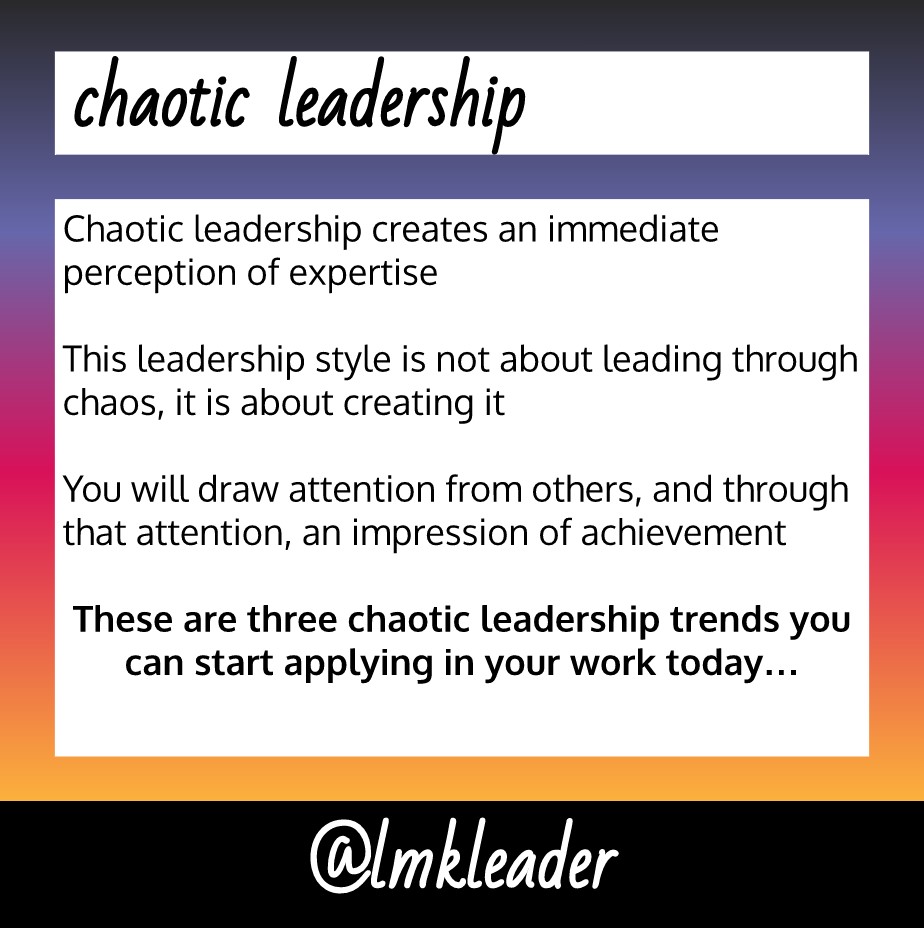
Chaotic Leadership is the latest in workplace leadership and management. It brings together components of traditional leadership styles such as servant leadership, strategic leadership, and coaching leadership – and disregards everything effective, productive, and inspirational in the spirit of unpredictability and confusion. This leadership style is not about leading through chaos, it is about creating it. It is only through creating chaos that you can foster an environment of constant change that will have a lasting impact on your company and the lives of the people who work for you.
disclaimer: Today’s post is an April Fools joke. DO NOT introduce chaotic leadership into your leadership style! (Even if without experiencing it firsthand, I wouldn’t have had so many examples for today.) LMK does not endorse the application of chaotic leadership.
Chaotic leadership creates an immediate perception of expertise and dependency. You will draw attention from others, and through that attention, an impression of achievement.
As a chaotic leader, you want to create an environment that is unstable. You are looking for opportunities to shake up the status quo. If your company is in a transitional period, or you have taken on a new role or new responsibilities, this is the perfect time to demonstrate your chaotic leadership style.
These are three chaotic leadership trends you can start applying today to demonstrate to your team and your company that you are a trusted, experienced, and qualified leader.
Be a chaotic people developer: The team of people working for you will look to your help to build their skills, get new opportunities, and grow their careers. You will want to keep these things in mind to ensure your team feels embedded in the chaos culture.
- Few things will make you look stronger than if the people who work for you appear weak in comparison. Project your insecurities onto people on your team by making broad and public announcements about their shortcomings, but be sure to praise them in private.
- Withhold career-related communications that you are instructed to distribute to your team. This will show your team how much they need you. This includes performance reviews or promotion requirements.
- Providing actionable performance feedback to direct reports is antiquated and not suited for the agile world. Your team should be able to dynamically adjust to your expectations in real time with little to no conversation.
- If you ever need to have a difficult conversation with a direct report, put it off for as long as possible. Ideally, you should put it off until they notice something and they bring it up to you. This works for pay cuts, role and responsibility changes, and even firings. If you are upfront and transparent, your team will not respect you.
Be a chaotic manager: A large part of your leadership role is likely to include management. You will spend most of the day making decisions, and your team will look to you to provide direction or instruction on how to complete their work.
- Your team will escalate issues to you for your help or support. To avoid appearing predictable, you have two options. First, you can outright deny their request for support and tell them you’re actually supporting the opposing side and will be working against them. As a second option, you can reassure them of your help and mutually agree on a path forward. At the next opportunity, such as in a public forum, deny your support and the previous agreement.
- When there is a problem, demonstrate your position as a leader by finding someone to blame for the problem. Because you are conducting a “root cause analysis” you do not need to help find a solution.
- Insert yourself into every process to make sure you are comfortable with the oversight you are providing. Make sure work does not get done without your approval on every task, communication, or deliverable, no matter how small.
- Cut your team out of big decisions on projects that they are involved in, and do not let them know about these decisions. As a leader, you want to be positioned to make unilateral decisions without your team’s knowledge or involvement.
Be a chaotic communicator: As a leader, you will be communicating with the team of people who work for you, stakeholders, vendors, and other leaders. You will want to demonstrate your chaotic communication style to these groups.
- Use superfluous language when speaking. The perception of expertise is paramount when communicating with others. The best way to achieve that is to make them think you know more than they do by using confusing speech, and even made-up words if needed.
- Strawman arguments and red herrings are highly effective communication tools. When you do not agree with a decision or do not want to answer the question, these are the best ways to distract from the discussion to ultimately get your way.
- When you are hosting a meeting, there is no need to provide an agenda or track action items or outcomes. If it looks like you might end early, introduce other topics to use up the time. This demonstrates to others that you are in charge of how their time at work is spent.
Chaotic leadership will ensure your company sees you as a dependable expert in your field, and that your team understands that you are qualified to be their leader. This outcome will ensure a successful career path for yourself.
Why wouldn’t it?


Leave a Reply