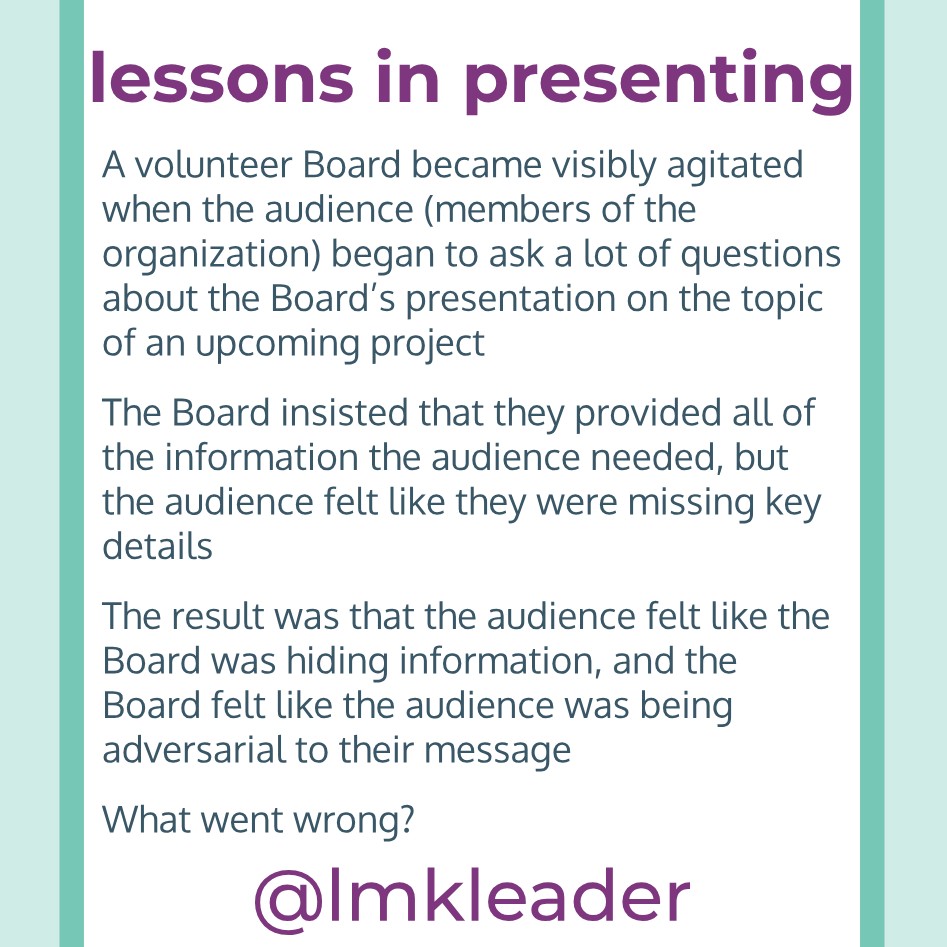
At a poorly organized meeting, a group of presenters became visibly agitated when the audience began to ask a lot of questions about the material. A few people in the audience explained that the reason for the apparent interrogation was that the presentation lacked a lot of key information that they were looking forward to receiving in the meeting. The presenters argued that they provided all of the information that the audience needed. The result was that the audience felt like the presenters were hiding information, and the presenters felt like the audience was being personally adversarial to their message.
This was not a good meeting for anyone in the room, simply because of the presentation. Witnessing this ordeal prompted me to revisit the topic of presenting and public speaking and put it in the context of this real example.
Back in December of 2023, I posted about presenting and public speaking: https://lmkleader.com/2023/12/09/presenting-and-public-speaking. The article was about the act of preparing for and making a presentation: knowing your audience, organizing your information, and anticipating questions.
To summarize the background of this real-world example, the presenters in this meeting are a volunteer Board presenting to an Organization about a new project that requires funding approval. The audience consists of members of the Organization who will vote on the material the Board is presenting. The Board will need the Organization’s approval to secure the funding for the project during a future meeting.
The Board has been working on this project for the last 3 years. The Board presented to the Organization for the very first time 6 months ago. They took the feedback from the Organization into account and were presenting on a revised version of the project. They presented for 15 minutes and took over 2 hours of questions from the audience.
What went wrong in the Board’s presentation and what are some lessons learned from this example?
Lesson 1: Know your audience
In this real-world example, the Board did not appropriately empathize with their audience in the planning of their presentation. Although they are also members of the Organization, the Board needed to acknowledge these fundamental points about their audience:
- The Organization’s members have a personal interest in the budget allocated for this project. They want to know how much this project will cost them. The Board presented the total cost of the project, but they skimmed the details about what was included in the project scope to add up to the total cost.
- The Organization’s members want to know how the money is going to be spent. They want to know what they are getting out of this project. The Board highlighted what they removed from the scope since the previous meeting, but they never detailed what remained.
The Board presented a multimillion-dollar price tag to the Organization, with no knowledge shared with the Organization of what exactly that money was going to be spent on. Because the Board did not understand what the audience wanted to hear about in the meeting, they didn’t present the information that the audience wanted to hear.
Lesson 2: Organize the information
This was both a persuasive presentation (to convince the audience to invest in this project) and a factual presentation (to present a budget and project scope to an audience new to the topic). Both the persuasive and factual aspects failed in this presentation.
The Board spent most of the meeting describing how they spent the last 3 years working on gathering the information for the project to present to the Organization. They neglected to tie the outcome of how the pre-work led to today’s presentation. This could have been a persuasive approach in describing how the previous 3 years’ work led to today’s presentation, but they did not tie that information to the present day.
Organizing information is also effective storytelling. The Board needed to tie their historical work directly to the outcome. Again, because this was entirely new information for the audience, it needed to be as simple as “our work equals this outcome”. There was no throughline from the work to the outcome for the audience, and so the information was disjointed and incomplete.
Lesson 3: Anticipate questions
This is where the Board really failed. Despite allocating time to questions, they didn’t anticipate them and appeared to take it personally when they received so many. If they had reviewed their material and anticipated questions, they would have updated their presentation or prepared for how to respond.
The Board kept reverting back to something I have seen a lot when people get defensive when presenting a persuasive research topic: they kept citing how much work they put into this effort. Instead of answering the questions or saying they would provide the information later to the Organization, they would repeatedly answer, “We have been working on this for 3 years.”
This kind of response also ties back to Lessons #1 and #2 above. The Board is composed of experts in the project, and their audience is new to the project and needs simple communication and baseline information. Had the Board successfully tied their work to the outcome of their presentation, and had they known their audience, they would not have answered questions defensively. The Board took the novice status of their audience for granted.
These three lessons are closely linked. If you know your audience, you can organize the information, tell an effective story in a format the audience can understand, you can anticipate their questions, and ultimately communicate your message.
 lmkleader.com
Leave a comment