Have you ever been expected to quickly grasp a new concept to solve a problem or make an important decision? In such cases, there often isn’t enough time to do extensive research or dive into details. Conferences, webinars, and trainings usually introduce new ideas with more time to absorb new ideas, but when dealing with immediate challenges at work, you must tackle unfamiliar concepts swiftly.
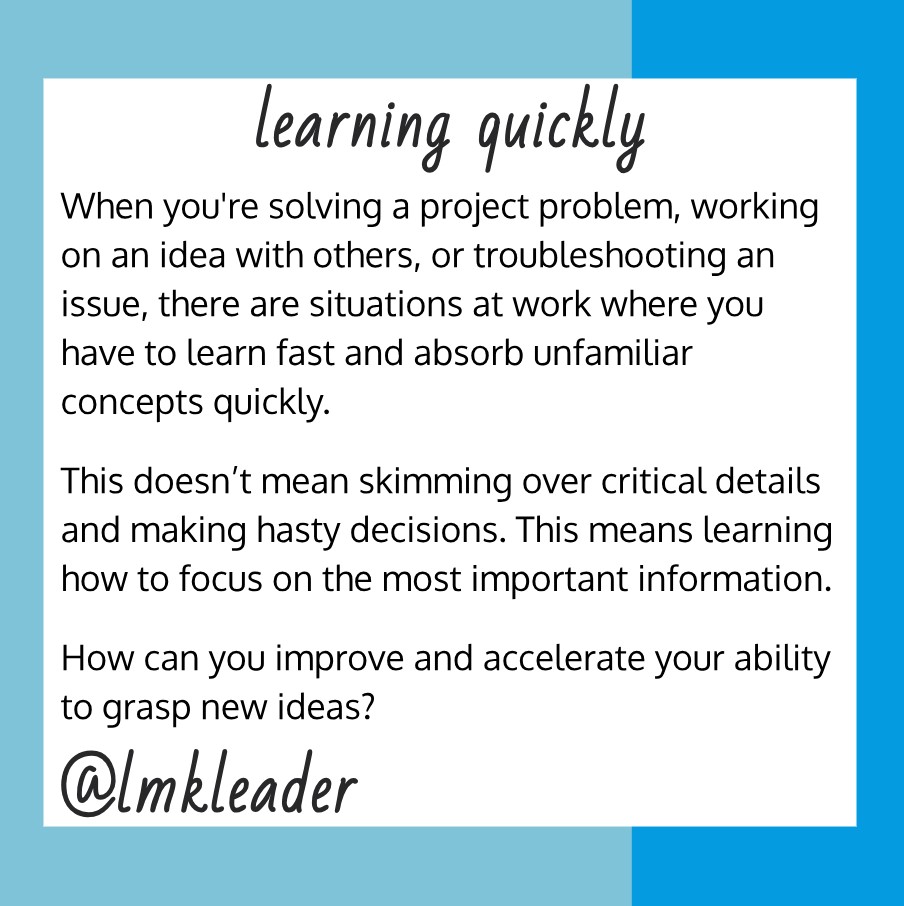
This is a post about learning how to learn faster in the workplace. Whether you’re solving a project problem, working on an idea with others, or troubleshooting an issue, there are situations at work where you simply have to learn fast and absorb unfamiliar concepts quickly.
When you’re given ample time to learn about a new subject or idea, you might like to read articles or books, watch videos or documentaries, or talk to people knowledgeable on the subject. You can also quickly comprehend new information if you’re already familiar with similar concepts.
In reality, you will encounter new information and won’t have the time or background to take in the information in the most comfortable way possible. You will have to absorb the new information and keep moving with the project or decision. This doesn’t mean skimming over critical details and making hasty decisions. This means learning how to focus on the most important information to make the right decisions.
How can you improve and accelerate your ability to grasp new ideas?
Know your learning style
The first step in learning how to learn faster is to be familiar with your preferred learning style. Understanding how you best absorb information will help to make sure the information you need to learn is presented in that manner from the get-go. You will immediately know to change the information to the format you prefer, and you won’t waste time trying to understand information that’s presented in a way that’s going to be difficult to take in.
Some quick examples of learning styles are:
- Visual – viewing pictures and diagrams to understand information
- Auditory – listening to understand information
- Verbal – reading to understand information
- Physical – using body, hands, and sense of touch to understand information
- Logical – using process flows or systems to understand information
If you’re an auditory learner then you might need to hear the information read aloud, if you’re a visual learner you might need the information presented in pictures. You might also prefer a mix of styles depending on the information. Take some time to recognize your preferred learning style.
Recently, I had to help troubleshoot an issue in a finance system. I didn’t know a lot about the system or the financial processes that were under consideration before the issue was brought up. When the issue was being explained to me verbally, I could not understand the information. However, when someone was able to walk through the process by sharing their screen and showing the steps in the system, I was able to understand the process and the problem. In this case, I needed both visual and logical learning styles to comprehend the concept.
Focus on the key points
What is the minimum amount of information you need to understand new information and what information is the most crucial to focus on learning? The second key to learning quickly is to break down information into small pieces and figure out what is most important.
When faced with new information, the subject matter can be vast. However, you don’t need to memorize the entire dictionary to be able to define one word. You only need to look up that one word to find the definition. Think of any workplace problem in your given profession – you probably don’t need to possess encyclopedic knowledge of your entire profession to solve each problem you’re faced with each day. The same can be true when learning new information at work.
Start by breaking down new information into smaller pieces. Use your learning style or work with someone else who is close to the knowledge to break the information down. From there, you can identify which is most important to the discussion or problem at hand. It’s going to be very specific to your particular situation, so try to identify – what do you need to know right now to move forward?
Continuing with the same example as above. When I was able to understand the end-to-end process being described to me, I could pinpoint where the issue was in the process, and I could focus on learning more about that one step in the process. My time was best spent on that critical step that was causing issues and I did not have to spend any time on learning details about other parts of the process. In quickly understanding where the problem was, I could move quickly through the education process for myself and come to a solution for the problem.
Don’t memorize, Learn
The final step in learning quickly is to focus on understanding the information, not just memorizing it. This ties back to the first step in knowing your learning style. The intent is to learn, absorb, understand, comprehend. This is information you will be able to recall. If you are using this knowledge to make a decision today, you’ll be able to call back to explain the intent behind your decision later. You’ll also be able to use this newfound knowledge in the future.
 lmkleader.com
Leave a comment