In honor of April Fool’s Day, LMK presents a quick guide to supporting never working from home again.
Return to Office is an ongoing debate within workplaces and between leadership and employees. Managers claim employees are less productive while working from home, while employees report higher productivity and more meaningful hours spent working while working from home. Before 2020, many workplaces allowed employees to work remotely or “telework” as a means of flexibility and access. Then the pandemic shifted more companies to complete or partial remote work status. Four years after the pandemic started, company leaders and managers want employees back in the office full-time, regardless of their status pre-pandemic.
disclaimer: Today’s post is an April Fools joke. It is presented in a tone of sarcasm. LMK does not endorse the sincere application of the ideas presented in this post.
Certain kinds of work environments necessitate in-person services. But for those who have had the option to work remotely or on a hybrid schedule since the pandemic began in March 2020, there is an ongoing debate about whether this practice should continue.
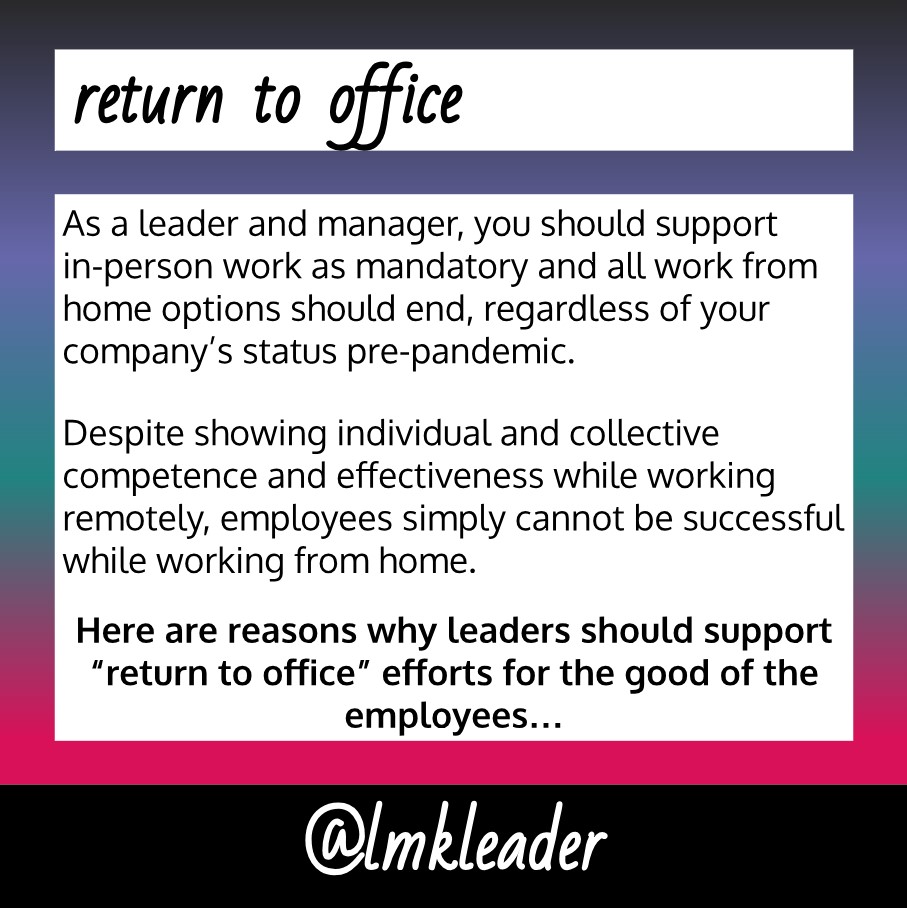
As a manager, you should be well-versed in the many reasons why in-person work should be mandatory. Despite having the tools to be productive while working remotely, and despite showing individual and collective competence and effectiveness while working remotely, employees simply cannot be successful while working from home. A marker of a true leader who is connected to the business is the feeling that employees are not as productive as they could be, even when the statistics prove otherwise.
Here are some reasons why leaders should support “return to office” efforts:
It’s important to spend time commuting
Time spent commuting is good for well-being. Employees can use commute time to take personal phone calls, listen to podcasts, or exist in silence while avoiding the people they live with. An average of 72 minutes a day that could be spent commuting is now wasted as productive personal or work time when it should be spent sitting in bumper-to-bumper traffic or sweating profusely through your business casual attire on public transportation. Local transit systems also rely on use of them to stay afloat. The commuter rail system may have reduced hours and number of trains years before the pandemic and that may have negatively impacted your commute back then. But now, public transportation is struggling to return to more convenient options because no one has returned to the office. If employees return to commuting, more service options will return, it’s guaranteed. The ritual of commuting is more important to the company than the number of quality hours working, and it is more important to the employee experience to spend that time in transit than doing anything else.
It’s important for the perception of leadership
The CEO needs to see that people are using the office space that the company already paid for, and he needs to see employees physically present to believe they are working to make money for the company (and to pay for this space). He might take a walk through the office at any time unannounced, and employees should be prepared. Even though the CEO does not live in the metropolitan area of our office building and spends most of his time working remotely, there is a chance he might show up in the office. Given that, employees should want to provide the CEO with the perception that everyone is hard at work. If the CEO sees an empty office, he will think the company is not productive. It’s that simple.
It’s important for commercial real estate and surrounding businesses
Commercial real estate and downtown businesses around our office are suffering because everyone in this company continues to work from home. We up-sized our office space in 2021 when we signed a 20-year lease for an office that can accommodate three times as many people than this company has ever employed. This business decision was made while we were engaged in over a year of full-time remote work for the entire company and that decision to expand our office space now has to be justified. It’s also worth noting that the nearby Starbucks, Chop’t, and Potbelly are going out of business without our support. They opened in this location to serve our office building. Although the office building is not being used, and so there is no practical reason for these businesses to be in this location any more, it is now our business decision to help these companies sustain their business decisions. It’s everyone’s responsibility at this company to contribute to justifying our lease and to patronizing the local chain businesses.
Managers and leaders can use this information today to support why employees should return to in-person work. These three reasons support both the employees and the economics of the company. Even if employees seem like they can contribute meaningfully while working remotely – Can they really? None of the other aspects of their lives that are supported by remote work (such as child care or health care) should matter as much as being physically present in an office doing their work.
To all the managers who made their career while working in an office 5 days a week, just remind yourself: “I made my career in an office so everyone else should have to do the same.”
 lmkleader.com
Leave a comment