When I started LMK, I expected the stories to be directed toward general personal improvement areas. However, I realized there were a lot of work-related interactions and stories I was having that would not fit into the neat box of these improvement areas. These are personal approaches to leadership and some of the lessons I learned along the way. -kendra@lmk
The more you manage teams of people, the more personalities you come across, and the more likely it is that the people who work for you will not “fall in line” or comply with your ideas and direction one hundred percent of the time. Change Management is the practice of managing people through a change and in support of change adoption. As an example, in managing the implementation of a new software system, you would use Change Management to help stakeholders learn, understand, and adopt the new system. Typically applied to project stakeholders and in alignment with project management, Change Management tools and concepts can also be used to manage your team in their day-to-day work.
For other LMK topics related to managing teams, check out these posts: managing others, delegating, and difficult conversations with direct reports.
There are many different applications of the role of team lead or team manager that can depend upon your organizational or project structure. This post specifically addresses the scenario when you are overseeing a group as the team leader, and you are responsible for directing people to complete work. You may be a formal manager of this team all the time, or appointed only for a short project. You may have to also oversee the career paths of the direct reports who are working for you in this situation. There are many different real world applications of being a team leader depending on your job and industry.
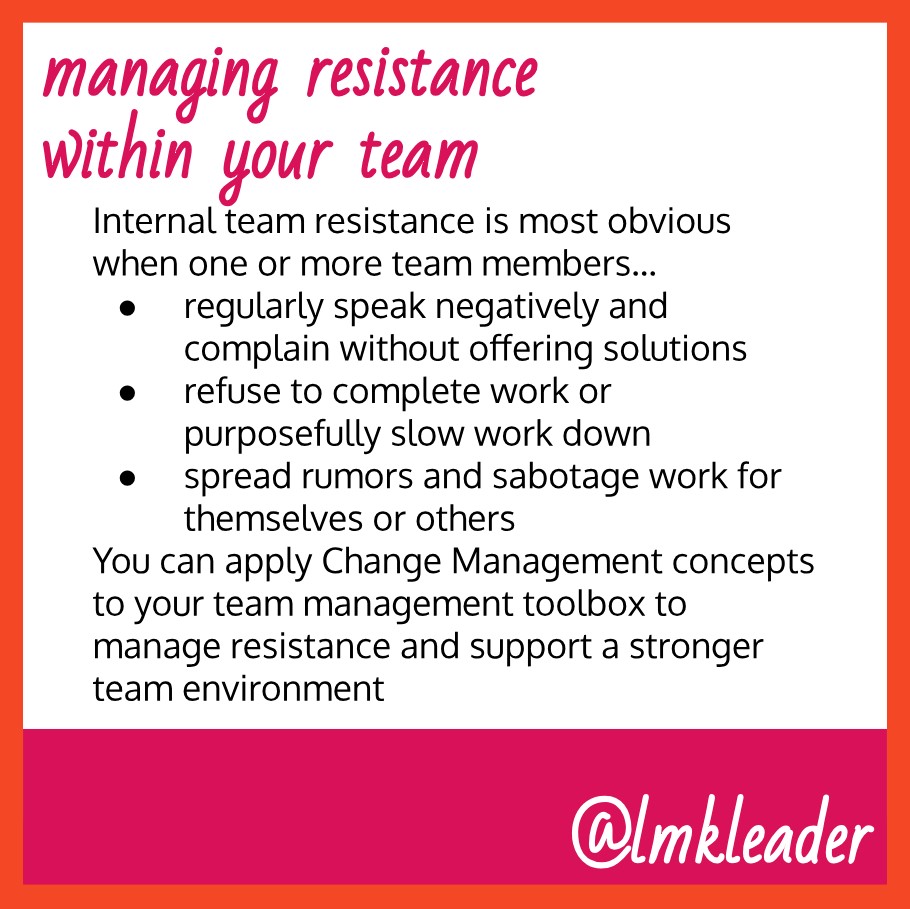
As a team lead, you will likely encounter direct reports that put up resistance to your leadership or management. Internal team resistance may manifest and be most obvious when one or more team members…
- regularly speak negatively and complain without offering solutions
- refuse to complete work or purposefully slow work down
- spread rumors and sabotage work for themselves or others
The Change Management practice in the traditional sense serves to help people overcome negative reactions to a change introduced with a project. Change Management concepts are intended to identify and analyze the motivations, skills, and working styles of the individuals involved in a project, and then manage the individuals through the change with the consideration of those factors. Change Management helps us manage and lead people while recognizing that they are unique individuals.
Whether or not a change is happening to your team, you can apply Change Management concepts to your day-to-day team management toolbox to help manage internal team resistance and support a stronger team environment.
Get to know the individuals on your team
In Change Management, stakeholder identification, analysis, and engagement is the baseline for effectively managing change in a project. These steps involve listing out everyone that the project involves or affects, analyzing their power, influence, interests, and attitudes, and then planning and executing their involvement in the project. All of these tasks are done to help the stakeholders understand and accept the change, and manage their resistance to the change. The same principles can be applied to your team to cultivate the best possible team environment.
You already know who the individuals are on your team, and this is your opportunity to get to know them. If it helps, similarly to formal Change Management, document the information you gather so you can reference it later. Get to know your team individually in these key areas:
- History and background: Get to know each person’s professional background. Their professional and educational history, their history with the company or similar companies. This helps set the baseline for what historical knowledge they are bringing to the team environment, and it is workplace-appropriate to have these kinds of conversations. If your work is mission-based, it could help to know if they have a personal connection to the mission as well. However, be careful when asking your direct reports about their personal lives and keep it focused on work unless they offer personal information voluntarily and without being asked about it.
- Interest and concern: Understand your direct reports’ interest in projects, in the company, and in their own careers. This helps inform their motivations for wanting to know certain information and for wanting to be part of certain projects. This kind of information will help you make sure you are involving the right people on your team in the right opportunities. It will also help you get ahead of any sort of conflict that is caused by internal project miscommunications. For example, you will better understand why an honest mistake by someone is being taken personally by someone else if you know personal career motivations.
- Attitude and tolerance for change, conflict, and disruption: Get to know how the individuals on your team handle setbacks and disagreements. This kind of information will likely come slowly and through experience, however, it is very valuable to understand how everyone responds in these kinds of negative situations. If someone does not handle setbacks well, you can also help them learn how to build resilience.
Prioritize communication and transparency
In Change Management, a Communication Plan would serve to plan and execute the communication methods, frequency, and content used to interact with the stakeholders of your project. Planning for the communication needs of individuals or groups involved in a project helps to inform in a way that is appropriate and comprehensible to the audience. Communication for projects can involve one-way updates regarding the project purpose, timeline, and roles and responsibilities, as well as two-way communication channels such as feedback forums that further promote engagement and information sharing.
These should all sound like familiar exercises for a team lead or manager. You should be transparent and flexible in how you approach communication with your project stakeholders and with the team you are leading.
To incorporate these concepts into your internal team management, consider this when communicating with your team:
- Customize communication based on the needs of the people you are leading. Use language that is understandable to all, and use a format that is receptive to all. Establish where certain types of communication happen so everyone knows where to anticipate finding certain team-related news.
- When delivering a decision, explain why that decision was made by yourself or others. This builds trust within the team towards you as a leader and also teaches the members of the team the thought process behind business decisions.
- Involve the team in decision-making when appropriate. This builds a sense of ownership and commitment within the team towards overall goals.
- Create forums for conversation and questions. Two-way communication channels are imperative for the success of teams. When your team sees that they have a communication channel with you, the better your relationship will be with them, and the better the team will function overall.
Continuously learn and improve
A key part of any Change Management, or Project Management, practice is continuous monitoring and adjusting to outcomes or feedback. This is also true of managing a team and the advice here. If anything is not working and outcomes are not as you expected, take the time to learn, make adjustments, and improve.
For example, if it does not seem like a direct report is responding to your directions, take steps to adjust your delivery. Consider asking them directly what it is that needs to be changed. An easy way of phrasing this is, “I’ve been posting weekly team assignments to the team channel, but it seems like you did not get the last few messages. What was the reason for that? Is there another way I can deliver this information? Would that solve the problem?”
If the situation requires an approach to a serious matter, such as an individual within the team who continues to show resistance and disrupt the team environment, it will be necessary to address the issue candidly. Directly address the individual using the approach outlined here as well as conflict resolution techniques.
Remember to use “I” statements as much as possible to express your observations. When you use too many “you” statements, the recipient of the information can become defensive. Also, keep the conversation respectful, and remain curious. In the spirit of Change Management, your first goal should be to understand where it is they are coming from. As a person who may be showing resistance for a reason related to their history, background, or motivations, it’s important to empathize and then work towards a resolution.
By using Change Management in your internal team management approach, you can get ahead of impending resistance or alleviate existing resistance. These concepts will help you build trust and manage through difficult times by learning how best to manage your team as individuals.
 lmkleader.com
Leave a comment