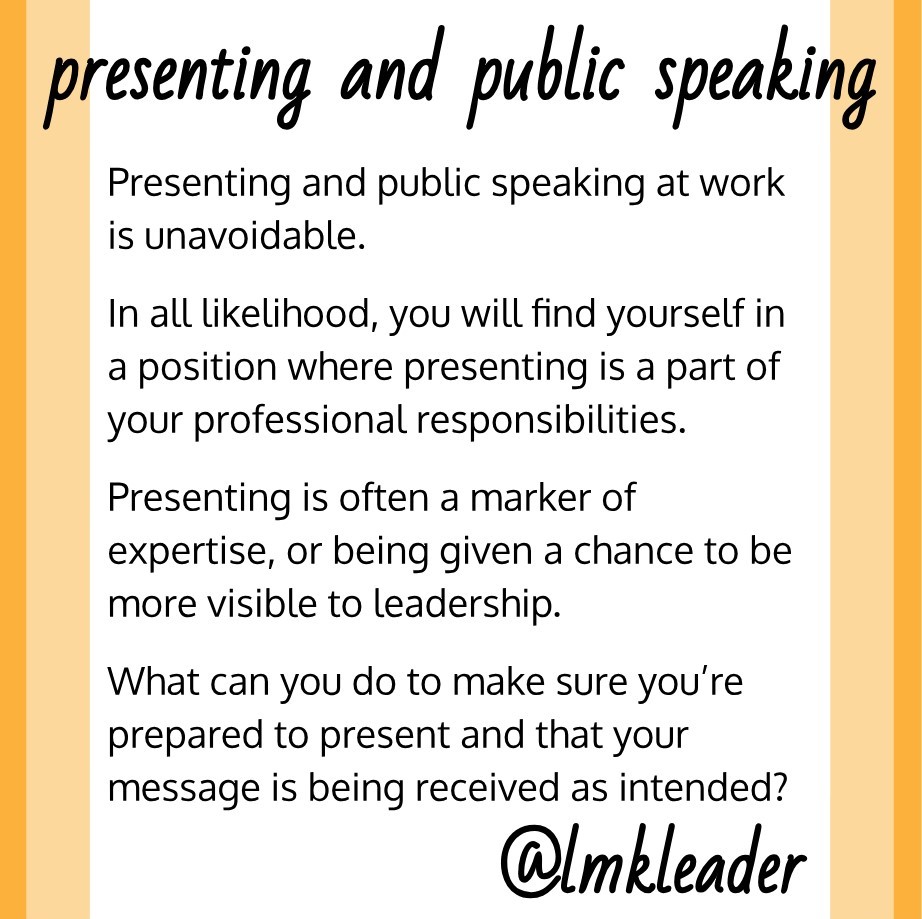
Presentations and public speaking continue to be the most popular way to convey information to a group of people. In other words, it’s inescapable. There’s no doubt you’ve been in the audience of some very good presentations and also some very bad presentations. Did you take the time to think about what made that presentation good or bad? For example, was it the charisma of the speaker, the wording they used to share their message, or the content they were presenting?
For some people, giving a presentation is horrifying, and for others, it’s monotonous. In all likelihood, you will find yourself in a position where presenting is a part of your professional responsibilities. Presenting is often a marker of expertise, or being given a chance to be more visible to leadership. What can you do to make sure you’re prepared for every presentation and every public speaking engagement?
When you’re talking to a group of people at work, you want to be prepared and confident in your delivery, and you also want the audience to receive your message as intended. You’re giving this presentation because you are the expert on the topic and you know the most about it. If that’s not the case, then preparing in terms of learning the material is the first place to start. After that, you will need to present the material in the most comprehensible manner for the audience.
The scope of presenting and public speaking is substantial, therefore this post focuses on areas that apply to the majority of workplace presentation scenarios. First, this topic assumes that you’re addressing a group of people. The group could be a large group or a small one, and it could be remote or in person. Second, the objective of your presentation is to communicate information on a topic. Presentations can vary in purpose (for example, information sharing, persuasion, status updates), but all presentations should have a clear objective.
Here are three things to keep in mind the next time you’re presenting or public speaking to boost your confidence and ensure your message is being received as intended:
1. Know your audience
The audience to whom you’re presenting will inform how you’re presenting, what you’re presenting, and what questions you will get on the subject.
Unless you’re presenting research to a group of scholars familiar with the topic, use simple language. Do not use buzzwords or flowery speech. It will not impress the audience if they do not understand you.
Try to find out if anyone in the audience needs accommodations to receive the information and what accommodations you need to make to deliver it.
Executives want to know the business impact of the information they receive. They will want to know the schedule, budget, and high-level objectives.
Most people outside of the c-suite will want to know how it affects them and their day-to-day.
2. Organize the information
The information you are presenting needs to be organized to be understood and retained by the audience. Most presentations can be simplified and structured in the same pattern and with the same considerations.
Say the objective upfront and repeat it again at the end. This helps you collect your thoughts and stay on track, and it helps the audience follow and remember the purpose of your speech.
Summarize into three ideas or points. They say that if you present three ideas, then two will be retained by the audience. Keep information delivery as uncomplicated as possible. If you have visuals, keep them simple. Don’t use dense text.
Keep track of the time. Don’t go over your allocated time. Know the amount of time you have and keep track on a timer, or have someone else keep track of time for you.
3. Anticipate questions
Most presentation forums set aside time for the audience to ask questions. Regardless, people will still ask questions.
Make a list of questions you anticipate to receive. If you understand the audience and your content, you probably already know what you will be asked about.
Share your presentation topic with someone whom you trust at work and ask them what questions they would expect you to receive. A review of your topic by someone else can be used as an opportunity to adjust your presentation if needed.
Despite all of this preparation – If you’re asked a question and you don’t have an answer, it is acceptable to say “I will get back to you” or “I will follow up with you at the end of this presentation.”
Remember that getting better at presenting and public speaking requires the act of presenting and public speaking. The more often you do it, the more comfortable it becomes.
 lmkleader.com
Leave a comment