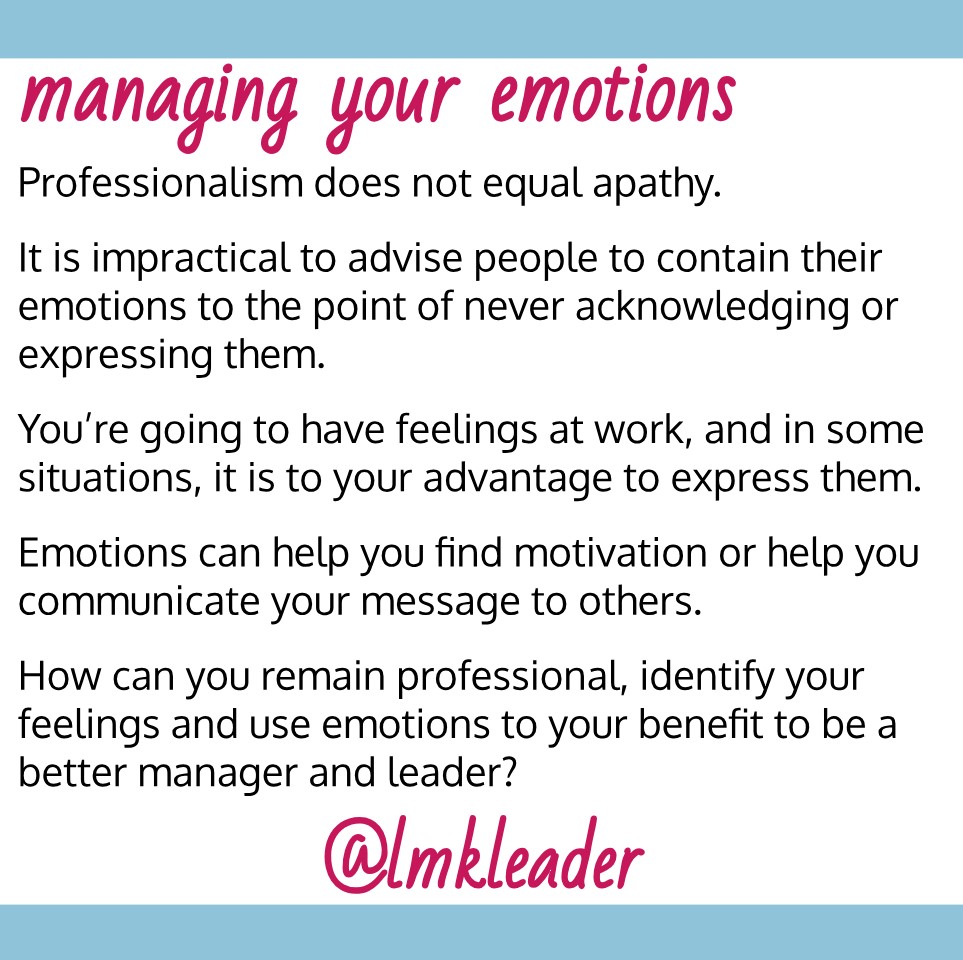
At work, you’re expected to be professional, and some people interpret that as you’re expected to be completely unemotional. However, in one single day of work, you could feel all sorts of emotions, positive and negative – anger, sadness, fear, frustration, excitement, and enthusiasm. Your day can be full of fantastic wins and causes for celebration. But work is also an unavoidable minefield of difficult situations. The workplace introduces you to personalities that you never could have even imagined existed in the world, and now you get to work with them on a daily basis. Add in the stress of the workload itself which can be daunting. It’s impossible to ignore your emotions, and it can sometimes help to show others how you are feeling, so how do you manage your emotions while still being an effective manager?
A note: The people you work with and their biases against you will factor into how you are perceived, especially when it comes to how you express your emotions. It is an unfortunate but true reality. Because of this, there is no one-size-fits-all solution to managing emotions. You will have to see what works best for you and your work environment. It is my hope that you can find a way to express yourself at work that is authentic and not stifled by the biases of others.
We’ve all been in the situation similar to this one – it’s Wednesday late morning during a work day, and it feels like it’s already been a 5-day week. The amount of work that needs to be done by Friday feels impossible, no one seems to be responsive, everyone seems to have a bad attitude, and your boss is coming across as the most unreasonable of the entire team. It’s enough to make you want to tell everyone off.
It’s important to manage extreme emotions because they can be counterproductive but it is impractical to advise people to contain their emotions entirely to the point of never acknowledging or expressing them. You’re going to have feelings at work, and in some situations, it is to your advantage to express them because they can help you find motivation within yourself, or help you communicate your message to others.
In situations like the one above, it’s imperative to be able to manage your emotions. Yelling at your coworkers and storming out of the office is not going to help the situation. How can you use how you’re feeling to your advantage?
Here are three things you can do to improve how you manage your emotions at work and also use them to your benefit:
Recognize the emotions you feel throughout the day
Can you identify and name the emotions you experience at work as they are happening? Start by observing all of the components that make your body and brain’s response to emotions. This includes your inner thoughts, your physical response, and your outward expressions to others. Remember, how you express your feelings includes what you say and how you say it – your facial expression, your tone of voice, your body language.
If you like to journal or keep notes as a method of reflection, throughout the day at regular intervals, or at the end of the day, write down how you felt at identified points during the day. (For example: “When Brad talked to me and gave me another assignment, I could feel my blood pressure increase and I was very short with him because it stressed me out.”)
If you would prefer to be in the moment, recognize the feelings as they’re happening. (For example: “Brad is here giving me another assignment. I can feel my blood pressure increasing. This is stressing me out.”)
Once you can identify your feelings and how you express them, you can begin to manage them. This can also be a good exercise in evaluating your work environment as a whole, especially if the negative emotions are taking over your 9-5 experience.
Use emotions to motivate you
Now that you can recognize your emotions and how you physically and mentally respond to them, you can work on turning emotions into something you use to your advantage. Emotions can internally motivate you to take action, speak up, make connections, and get work done. Enthusiasm, excitement, and passion can power you to your full potential as much as frustration, impatience, and envy can. It depends on who you are and what motivates you.
For the emotions that you are able to label in the moment, ask yourself “Is this emotion helping me and can I use this emotion to motivate me?” Only you will know what works for you, but here are some examples of what that could mean:
- If you’re feeling envious of a coworker getting opportunities, use that to motivate you to be more visible to leadership at work
- If you’re impatient because someone isn’t responding to your texts, use that to drive you to follow up by calling them
- If you’re extremely excited about starting a new project, use that energy to get ahead of the work before it begins
Your emotions can push you through fear and to accomplish new things. For emotions that aren’t serving you in a positive way, managing those emotions will involve calming them and moving them aside. If something is really too much to handle, try leaving the office for a walk or step away from your computer to reset, to physically remove yourself from the environment and prevent yourself from reacting in a detrimental way.
Strategically express yourself to others
There are times when an outward expression of your feelings can help you in work situations – such as when receiving or delivering bad news, in a negotiation, or delivering a persuasive presentation. When you recognize these situations, you have to be sure to express yourself in a measured and strategic manner.
Keep in mind that extreme emotional outbursts of any kind – from excitement, jumping up and down and shouting with joy, or anger, screaming at other people, and using harsh language – are disruptive to any relationship, especially those at work.
There are many books and articles on how to control your body language and tone of voice to others in a professional way – by keeping your voice neutral, your body language positive, etc. And all of them are extremely helpful and don’t need to be reiterated here.
Here are other ways to show your emotions at work to your advantage while keeping it professional.
- State your emotions. Stating your emotions can get through to others better than a reactionary expression of feelings would. Saying, in a neutral tone of voice, “I am not happy to hear this” or “I am disappointed” can have more impact than expecting others to infer those feelings through a negative tone of voice or body language. Sometimes it is more effective for people to hear the outcome and not have to infer it from other communication clues. This is especially true over virtual and remote communication channels, like emails or phone calls.
- Align your body language to your message. Whatever you are expressing through your body languages should align with the emotion you’re trying to communicate. If that is not appropriate for your situation, just keep it entirely neutral. In other words, don’t smile and nod throughout a presentation to then disagree with the entire thing at the end. This is extremely confusing for the recipient of your messaging, and does not help what you might be trying to get across. People will remember your smiling and nodding more than the fact you might have disagreed with the entire conversation. During remote calls, use your video camera to show a facial expression that aligns with your messaging, or simply maintain an impartial expression for a more cautious approach.
You can effectively manage your emotions at work by identifying them, using them to find motivation, and expressing them strategically. Are there other ways you’ve learned to manage your emotions that have helped you become a better manager and leader?

 lmkleader.com
Leave a comment