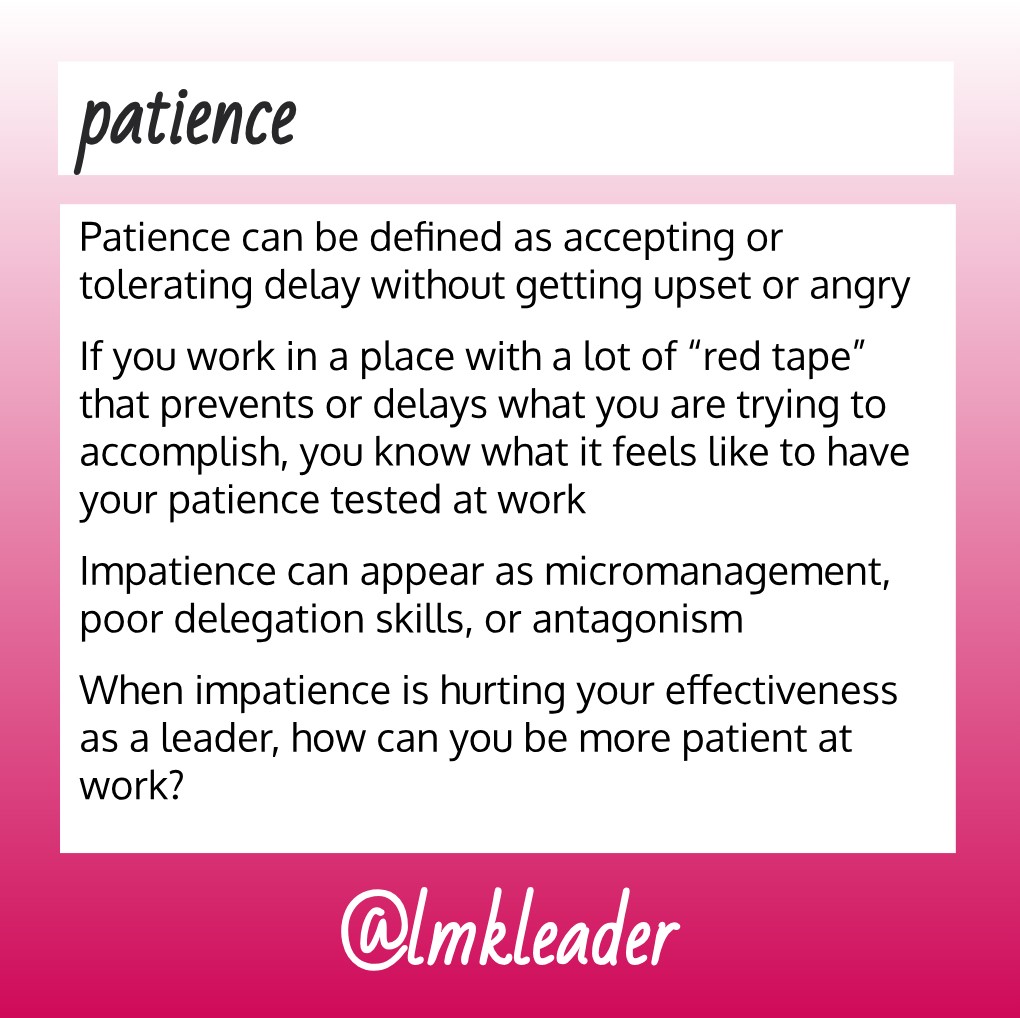
If you work in a place with a lot of “red tape” or process bureaucracy that prevents or delays what you are trying to accomplish, you know firsthand how your patience at work can be tested. The people you work with can also test your patience if it takes time to gain their buy-in or if you need to wait until they understand a concept you’re working on together. Time is precious, but sometimes it is worthwhile to be patient while you wait for the rest of the world to catch up with you. I know firsthand, this is my personal (sincere) answer to the interview question – “Tell me about your greatest weakness.”
Patience as a skill in the workplace can be defined as accepting or tolerating delay without getting upset or angry. Impatience, the lack of patience, at work doesn’t usually look good to others when you are a manager.
A lack of patience can appear as…
- Micromanagement – “I need to check in with you on this multiple times a day because it is taking too long.”
- Poor delegation skills – “It takes too long for anyone else to do it, I will do it myself.”
- Antagonism or chaos – “I told you to do this, you started on it, but I changed my mind, I will do it. I can’t wait for you. You’re off the project.”
You have to be able to identify the moments where exhibiting patience can be a management and leadership strategy. Being patient can serve you better than losing patience and appearing rushed or hostile. In other words, when is impatience hurting your effectiveness as a leader, and how can you be more patient at work?
Identify when you lose patience and your reaction
Take time to identify the moments at work that cause you to lose patience, and identify your reaction.
Are the moments when you lose patience related to a particular process or person? Is it always the same situation or does it vary? How often do you lose patience?
What is your reaction when you lose patience? Do you physically tense up, show anger outwardly, or use strong language? Are you able to control how you’re feeling in the moment, or is it obvious to everyone that you are frustrated?
You should work to identify what triggers you to lose patience and how you show others that you’ve lost patience. When you identify patterns, you can anticipate the situation before it happens and prepare yourself to handle it differently next time using the tactics below.
example: I used to work in an environment with a debilitating amount of bureaucracy. I work in software development, and it would take 5 business days to deploy code to the Test environment. This would mean that by the time the code was deployed and people were testing it, it would already be obsolete because there was a new version. By the time test bugs were resolved, the code was already two versions behind.
Every week, when the request was made to get the code migrated to the Test environment, I knew that I would have a negative reaction. Every week, the response would be that it would be completed in 5 days. Although it could be completed sooner, it simply wouldn’t be. My physical reaction to this would be that I would tense up in my shoulders. This was my weekly pattern in response to my impatience with this process – and the process was never going to change due to the organization, it was something I had to learn to accept and not become impatient over.
Be empathetic to the perspective of others
If you’re finding that you are getting impatient over the actions of specific people or the processes they oversee, take time to consider their experiences and perspectives. It’s easy to become impatient with someone who isn’t grasping a concept quickly or who isn’t completing a task quickly – according to your standards. This would seem to be the most common reason for losing patience with individuals at work. If you lose patience with your coworkers for this reason, you could appear difficult to work with or like a micromanager. Instead of getting angry with them, it would benefit you to take the time to empathize. Remember that everyone learns and works differently.
If you find yourself waiting on someone to complete a task, get to know their role and job function. They might have to complete a multiple step process before they get to complete the step you are waiting on, but you will only know if you ask and understand their process.
Consider their experience, and their expertise. You might have been able to grasp the concept quicker or complete the task quicker because you have the background or the tools to expedite it for yourself. They could benefit (and you could benefit) from your time spent teaching or developing their skills. Instead of losing patience, you could be a people developer.
example: This is a true story – There’s a system integration project that is behind schedule. The final process to validate the integration involves stakeholders from multiple departments completing tasks related to their job function within their respective system in a certain order. Stakeholders kept getting impatient with stakeholders from other departments for taking too long to complete their tasks. It turns out that everyone was completing their tasks as soon as it got to them, but some tasks inherently took longer to complete. This information helped educate everyone on the process, and helped introduce some much needed patience back into the project.
See the big picture
Take a step back. When you’re finding yourself becoming impatient at work, try to see the big picture. When we lose patience, it is oftentimes because we’re working too far in the details.
Consider the high-level implications of the situation you’re so frustrated about.
- Consider the timeline – Can this task wait?
- Consider the process – Are these steps necessary?
- Consider the stakeholders involved – Are they being impacted by the delay?
Usually, the answers to these questions are that it can wait, the process is necessary, and the stakeholders are not impacted. Seeing the big picture can help put the situation in perspective, and help you regain composure and patience. However, if the answers are the opposite, and the issue is worth escalating, remember to keep your cool about it as you communicate the situation!
example: This is my go-to tactic to regain perspective and composure. I must use it multiple times per week. My most recent example – A new project at work was supposed to begin two months ago. Stakeholders were bought in, funding was secured, and we were about to select a vendor. However, the executive sponsor and some stakeholders started introducing delays. It was a combination of negligence and chaos – and two months went by without any progress. Now the scope is possibly changing, and the key decision maker has lost interest.
I have only been able to stay patient throughout this entire ordeal because of the big picture. Yes, it is incredibly frustrating but we didn’t have a deadline we were up against and we are not losing funding. If it takes more time to get everyone back on board, we will do it. This project might be better for the delay in the end.
When you identify what causes you to lose patience, and show empathy and see the big picture in the face of impatience, you will be a better manager and leader. Sometimes, it can help to be a little impatient when things are taking too much time, processes are too cumbersome, and the business is being negatively affected due to these delays. Impatience can lead to discovering and implementing new efficiencies that help the company, and the people who make up the company, be more successful. In the same way, showing patience where it is needed, can help you and the company be more successful too.
 lmkleader.com
Leave a comment