When I started LMK, I expected the stories to be directed towards general personal improvement areas. However, I realized there were a lot of work-related interactions and stories I was having day-to-day which would not fit into the neat box of these improvement areas. These are one-off anecdotes, the approach I used, and the lessons I learned. -kendra@lmk
the insecure boss + micromanager
The fact is, we aren’t going to always get along with everyone we work with, and we aren’t always going to get along with our boss. Even the most amiable person on the planet (who I am not at all claiming to be) is bound to run into some personality conflicts in the workplace. I am not talking about differences in strategic direction or project approaches between you and your boss – I am talking about when your boss’s personality causes problems. This is what will be referred to as a Bad Boss.
Recently, I am becoming very familiar with working for the Bad Boss known as the “Insecure Boss.”
For what reasons an Insecure Boss feels insecure, you are welcome to figure out for yourself – ask them how they grew up, where they are from, how they got this position – and you will be on your way to solving that riddle.
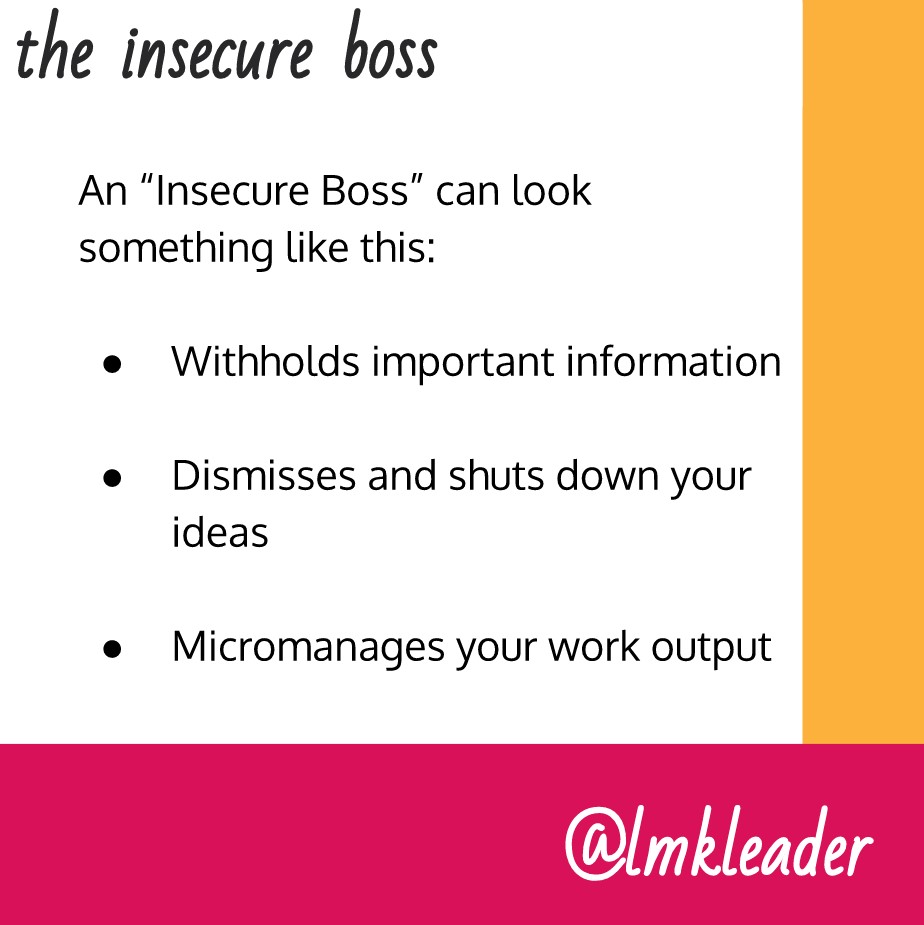
As for how this personality manifests at work, it can look something like this:
- Withholding important information and excluding you from forums to get information to do your job
- Dismissing and shutting down your ideas that are directly applicable to your job function or job description
- Micromanaging your work output to the point where it hurts productivity and undermines progress
At the end of the day, it genuinely seems like the Insecure Boss is out to ruin your career. None of these behaviors are supportive or productive. Bottlenecks and distrust abound when a team is run in this manner. Regardless, this person is convinced through their experiences that this is the best way to manage and lead.
You are not going to be able to navigate this Insecure Boss without a strategic approach – and for this post I am going to focus on what seems to be the Insecure Boss’s favorite activity above all else – micromanaging.
What to do when you are being micromanaged
Micromanaging from the top-down appears like a lack of trust in your abilities as an employee or contributor. It can affect us at our core. In reality, it likely comes from your boss’s lack of skills or lack of confidence in their skills of delegating, communicating, and monitoring work output. It is possible they are not familiar with the industry or project at hand, and micromanaging gives them a sense of control.
Ask for feedback and input
The best place to start is to try to understand what your boss’s priorities are, and how you can align your work or how you do work to those priorities. This is a very common response to a lot of workplace issues – “Just ask!” – and I believe this is the most straightforward path to solving most problems. It is also totally normal to have these kinds of conversations:
“What are your strategic objectives or performance goals for the year and how can I align my goals to yours and help you achieve them?”
“What can I do better in terms of reporting or escalation to keep you in the loop?”
Except with my Insecure Boss, I tried this, and it did not work. More due to my Insecure Boss’s chaotic management approach overall, and less due to insecurity. (But that’s for another post!)
Confront any bottlenecks or issues in productivity
If you have examples of what is going wrong because of the Bad Boss’s micromanagement, you should cite the examples and how it has impacted your work. Their management style is harming the business.
Unlike when having a critical conversation with someone who works for you, you have to be strategic in how this news is delivered. Be factual and direct when having this conversation, and offer solutions.
In a scenario where the Bad Boss inserted themselves to complete a task that they didn’t complete on time (or at all) –
“Can we talk about the missed approval deadline for the XYZ project? The next task is now delayed by a month. What can I do in the future to get that approval from you sooner? Should I have the document to you sooner, should I message you to remind you, or is there a way for me to be able to provide that approval myself?”
With my Insecure Boss, there has been some improvement using this approach. It’s something I continue to navigate.
Adapt to their micromanagement (within reason)
If you try the two suggestions above, and your Insecure Boss is a relentless micromanager, you may need to give a little. Something that has come up with my Insecure Boss is that they want every task tracked for every employee within the issue tracking system (we use Jira).
Insecure Boss, “As far as I am concerned, the work isn’t getting done unless I am able to see an issue for it in Jira”
A lot of the work my team does involves managing project schedules, tasks across many stakeholders, and vendors to do the development. We also do not track hours worked in my company. Even though there are tangible deliverables produced from our work, the micromanager needs to know how every minute of everyone’s day is spent, and that is what my boss has requested.
What the Insecure Boss really wants here is insight to how these projects are being executed. So how am I adapting (within reason)? I could track every single miniscule task to prove a point that this is tedious, time consuming, and not valuable – but the nuance of hyperbole would be a lost cause.
Instead, my team and I are taking the approach of using Jira as it was intended – to increase efficiency, productivity, and collaboration. We’re going to implement Jira on projects that don’t already use it to give the Insecure Boss the insight to project activities that they are looking for within Jira’s reporting features. We will start there and see if that is enough to comfort the Insecure Boss.
The more I read about the “Insecure Boss” archetype, the more I was able to identify, label and deal with interactions with my boss. It’s something I continue to work through on a daily basis. The good news is that if your boss continues to want to be involved in every meeting, every decision, and every email – they will tire themselves out. This management approach genuinely isn’t sustainable.
 lmkleader.com
Leave a comment